
What's the best way to learn a language? The Scribe method
The best approach combines spaced review, meaningful input, active recall, and regular use. Scribe Origins connects characters, vocabulary, and conversations without splitting progress across separate tools. This guide explains how to learn a language effectively and turn the method into a daily language learning routine you can actually sustain.

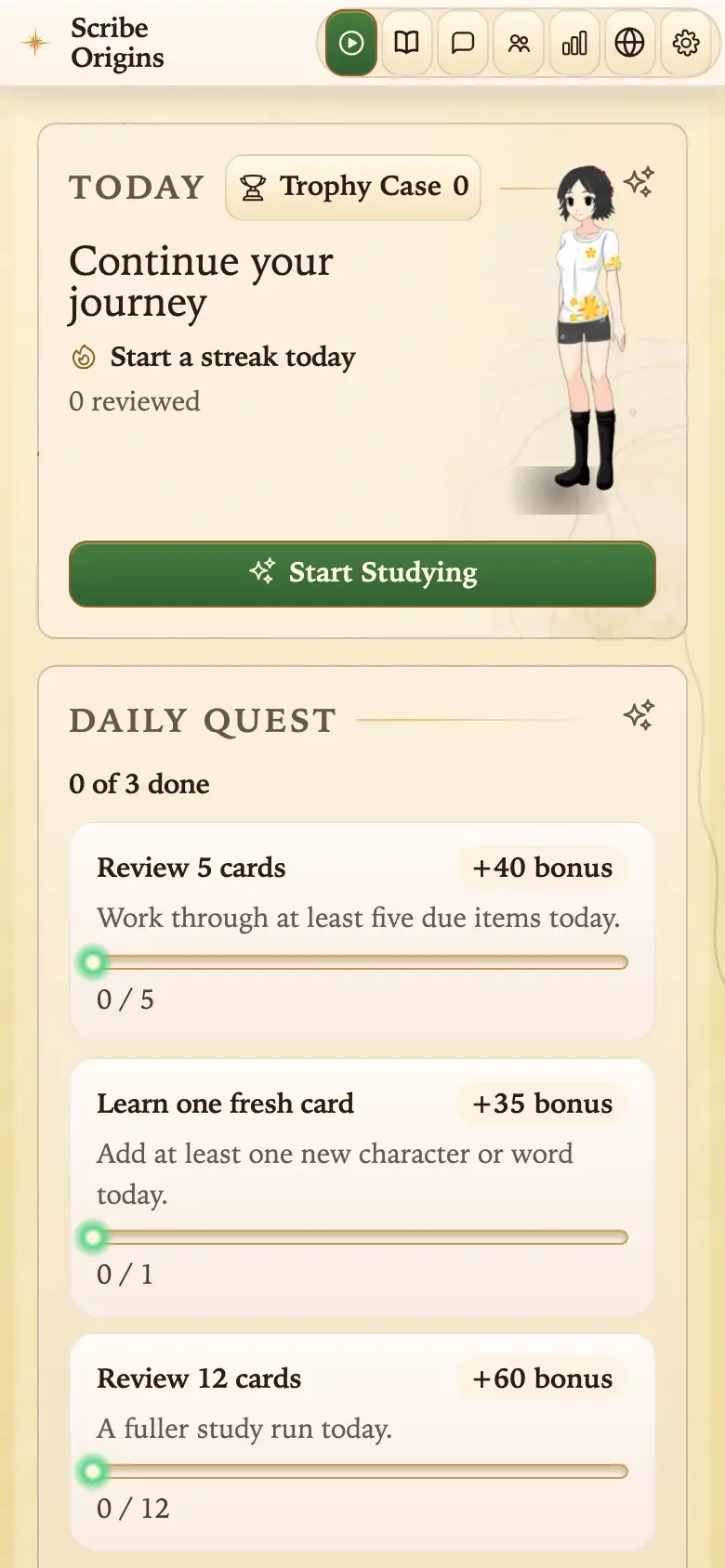
Overview
Why most language apps make this harder than it needs to be
Most language apps split reading, vocabulary, and conversation practice into different tools with different progress trackers. You might use a flashcard app for kanji, a separate app for vocabulary lists, and a phrasebook or chat app for conversations — and none of them know that the word you just reviewed in one is the exact same word you struggled with in another. That's a lot of duplicated effort, and it means an item you've genuinely mastered in one context can still show up as "new" somewhere else.
Scribe Origins takes a different approach. A kanji, a word, and a sentence you're studying each get exactly one review record, and that record is shared across every game and study mode in the app. Study 明日 as a flashcard on Monday, meet it again inside a scene conversation on Tuesday, and match it in a Tiles game on Wednesday — all three sessions read and write the same record, so your progress never fragments across modes. This single idea is the backbone of the whole method, and it's why the app can answer what's the best way to learn a language with a single coherent system rather than a pile of disconnected drills.
Study
One shared record, every game
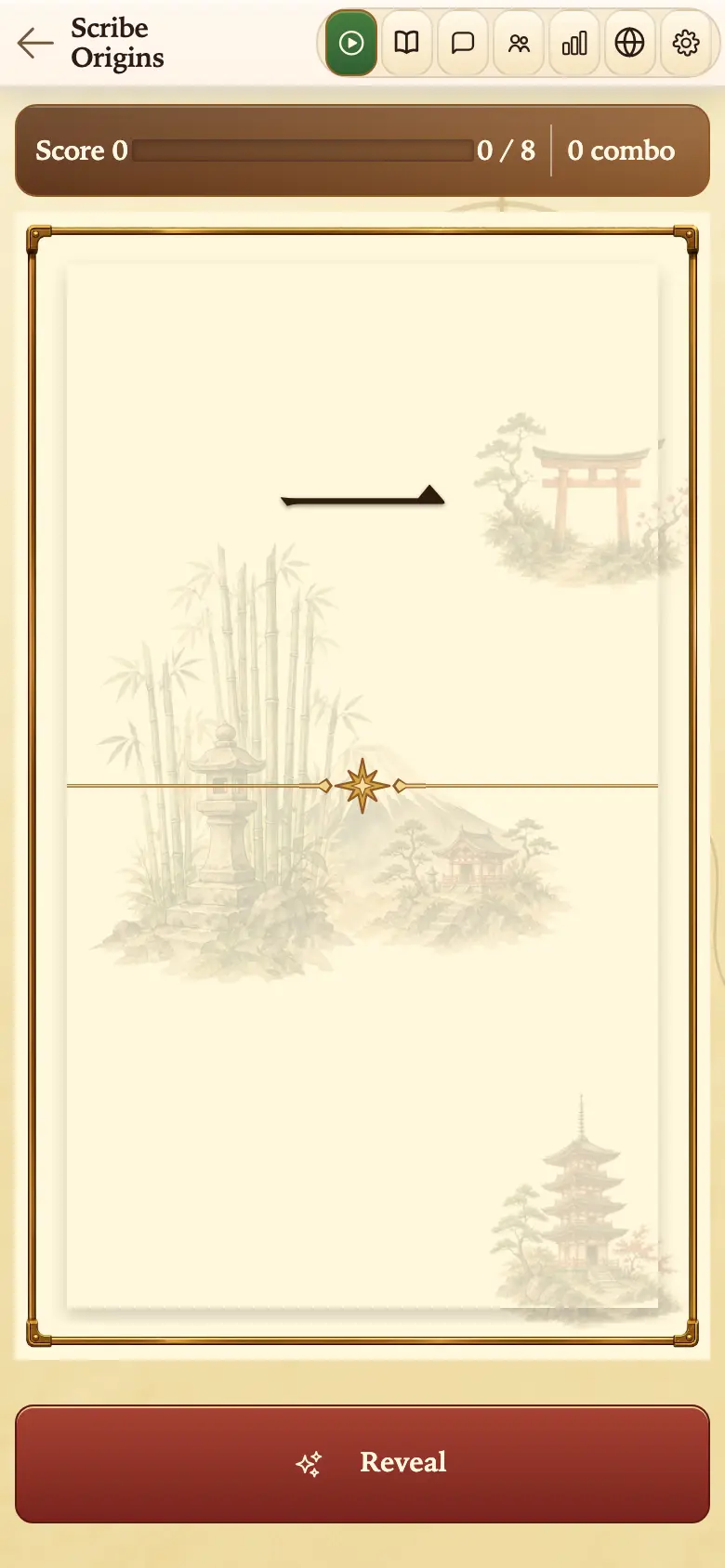
Whichever game you play — Flashcards, Multiple Choice, Tiles, Matchup, Character Builder, Blockfall, Tutor mode, or a Scene Conversation — you are reviewing the same underlying item. There is no separate "Tiles progress" or "Character Builder progress." When you rate a review again, hard, good, or easy, that rating updates the one record for that character, word, or sentence, which changes when it's next due no matter which game surfaces it. This is also why your due count on the home screen reflects everything you need to review, not just one game mode.
In practice, this changes how you should think about "switching games." Rather than treating each mode as a fresh deck, treat them as different windows onto the same pile of items:
- Flashcards and Multiple Choice are the fastest way to burn through a large due queue.
- Tiles and Matchup turn recall into a light memory-game, useful when flashcards start to feel repetitive.
- Character Builder and Blockfall lean on primitive and keyword recognition rather than pure recall.
- Scene Conversations put the same vocabulary and characters into a real sentence, with audio and multiple-choice replies.
- Tutor mode asks you to type the answer instead of picking or flipping, which is a stronger recall test once an item feels easy.
Because all five of these read and write the same record, rotating between them doesn't reset anything — it just gives you a different angle on material you're already tracking.
Characters
Primitive breakdown for characters
Chinese and Japanese characters are rarely random shapes — most are built from a smaller set of recurring components, often called primitives or radicals. Scribe Origins shows each character's primitives with their position labeled (top, bottom, left, right, outside, inside, or center), and every primitive is clickable, taking you straight to that primitive's own character page. Once you recognize a handful of primitives, new characters built from the same pieces become much faster to learn, because you're recognizing familiar parts instead of memorizing an unfamiliar whole.
This is one of the clearest answers to what's the best way to learn a language when the language uses a large character set: don't memorize thousands of characters as thousands of unrelated shapes. Learn the thirty or forty primitives that recur constantly, and every character after that becomes a recombination of pieces you already know.
Memory
Stories and personal notes
Every character and word carries an optional mnemonic story — a short, memorable explanation connecting the item's shape, sound, or meaning to something easier to picture. Built-in stories are included for many items, and you can write your own story or note on any character or word. Your note is saved as part of that item's shared record, so it appears every time the item comes up, in any game.
Mnemonic stories work best for the handful of items that keep tripping you up no matter how many times you review them. Rather than reviewing a stubborn item another twenty times, spend one minute writing a note that connects its shape or sound to something personal and vivid — the note sticks around permanently once you save it.
Scheduling
Four-level spaced repetition
After each review, you rate it again, hard, good, or easy. That rating adjusts the review interval for the shared record: again schedules a near-term retry, hard shortens the next gap slightly, good follows the normal schedule, and easy pushes the item further into the future. Ratings accumulate across whichever games you use, so the schedule always reflects your actual recent performance on that item — see how spaced repetition works for the full mechanics.
Here's how each rating changes the item's next review, roughly:
| Rating | What it means | Effect on next review |
|---|---|---|
| Again | You didn't recall it at all | Comes back very soon, often the same session |
| Hard | You recalled it, but it took effort | Shorter gap than the normal schedule |
| Good | You recalled it comfortably | Follows the standard spaced-repetition interval |
| Easy | It felt trivial | Pushed further out than normal — you've earned the break |
Getting started
Putting the method into practice
If you're starting from zero and want a concrete routine rather than just the theory above, here's a simple sequence that uses every part of the method:
- Open the home screen and check your due count — this already blends characters, vocabulary, and conversation lines into one number.
- Clear the due queue first with Flashcards or Multiple Choice, since these are the fastest way to work through a backlog.
- For any character that feels unfamiliar, open its detail page and read the primitive breakdown before trying to memorize the whole shape.
- Attach a short mnemonic story or note to anything you keep rating again or hard two sessions in a row.
- Rotate into Tiles, Matchup, Character Builder, or a Scene Conversation once the due queue is clear, so the same items get reinforced from a different angle.
- Rate every review honestly — again, hard, good, or easy — since the schedule only works if the ratings reflect how the review actually felt.
Repeat that loop daily and the spaced-repetition schedule does the heavy lifting: it naturally resurfaces what you're forgetting and backs off on what you already know, which is really the core answer to what's the best way to learn a language — consistent, honestly-rated review, not cramming.
FAQ
Common questions about the Scribe method
What's the best way to learn a language?
The most effective approach combines three things: reviewing items on a spaced-repetition schedule so you see them right before you'd forget them, breaking hard content (like Chinese and Japanese characters) into smaller recognizable pieces, and practicing the same vocabulary across more than one context — reading it, hearing it, and using it in a conversation. Scribe Origins builds all three into one shared system instead of three separate apps.
How long should I study a language every day?
Choose a focused daily minimum you can sustain. Fifteen minutes can maintain reviews and contact, while longer sessions create room for new input and production. A useful session retrieves older material, understands something meaningful, and produces a response before it ends. If fatigue makes your answers careless, stopping and returning tomorrow is more useful than protecting an arbitrary time target.
How is Scribe Origins different from other apps?
Most language apps keep characters, vocabulary, and conversation practice in separate tools with separate progress bars. Scribe Origins merges them: a character, a word, and a sentence each get exactly one review record, shared across every game and study mode in the app, so nothing you learn is ever tracked twice or forgotten because it lived in the "wrong" module.
Do characters, vocab and conversations share progress?
Yes. Study a character as a flashcard, meet the same character inside a scene conversation, and match it in a Tiles game — all three sessions read and write the exact same review record. Rating a review in any one of them changes when that item is next due everywhere else it appears.
Daily practice
What is the best way to learn a language every day with limited time?
There is no single activity that is the best way to learn every language, but a durable daily routine contains three actions: retrieve something already studied, understand a small amount of meaningful input, and produce a response. When people ask what is the best way to learn a language every day, the most practical answer is a repeatable session small enough to continue on busy days.
| Time available | Review | Input | Production |
|---|---|---|---|
| 10 minutes | 5 minutes of due cards | 3 minutes replaying a known scene | 2 minutes saying or typing three answers |
| 20 minutes | 8 minutes of due review | 7 minutes of a short dialogue or examples | 5 minutes varying sentences |
| 45 minutes | 15 minutes of mixed review | 15 minutes of a new lesson or reading | 15 minutes of tutor, writing, or conversation practice |
Keep the order flexible. A learner who avoids speaking can produce first; a learner with a large backlog can review first. The invariant is that the session includes both memory and meaning. Watching explanations for 45 minutes may feel productive but never tests whether the language can be recalled.
Four-week route
How can a beginner use Scribe Origins for the first month?
Week one: make the writing and sound system predictable
Choose one target language and the appropriate grammar guide. Learn the pronunciation or romanization conventions used in the guide. For Japanese or Chinese, begin recognizing a small set of recurring components; for alphabetic languages, focus on sound-spelling patterns and high-frequency sentence frames. Keep new material deliberately small while you learn how the review controls feel.
Week two: connect items to short sentences
Continue due review, but open dictionary examples and short conversation scenes. For every cluster of new words, identify one sentence pattern that can hold several of them. Practice changing a person, object, place, or time expression. This prevents the vocabulary list and grammar guide from becoming separate projects.
Week three: increase retrieval difficulty
Type or say answers before revealing them. Use Tutor mode, a construction game, or production-facing cards for items that have become too easy to recognize. Keep a short error list organized by cause: sound, form, meaning, grammar, or register. Fix the cause rather than merely counting the miss.
Week four: test transfer
Revisit an early scene without translation, write a short self-introduction or daily summary, and look up only the missing words. Compare the result with grammar references and community feedback. Choose next month's content from the gaps revealed by that attempt, not from an arbitrary desire to add more cards.
Measure progress
How do I know whether my language-learning method is working?
Track outcomes that describe ability, not only activity. Minutes, streaks, and scores can support consistency, but they do not show what you can understand or produce. Once a week, repeat one small task under similar conditions and record the result.
- Listening: how much of a familiar one-minute scene can you understand before reading subtitles?
- Reading: how many sentences can you follow without stopping for every unknown word?
- Recall: which due items can you answer before choices or hints appear?
- Production: can you create five new sentences with this week's pattern?
- Repair: do repeated mistakes disappear after you add a contrast, example, or prerequisite?
Expect uneven growth. Recognition usually improves before spontaneous speech; reading may accelerate once a writing system becomes familiar; listening can appear stalled until sound patterns become automatic. Compare your present performance with your own earlier sample, not with a fluent speaker's polished output.
Balance
How much new material should I add each day?
Add an amount that leaves room for tomorrow's reviews and today's meaningful use. If the due queue is rising for several days, pause or reduce new items. If review is quick and accurate but you cannot understand even simple material, spend more time on examples and input rather than increasing isolated cards.
Should I study one topic or mix several?
Use a narrow topic for initial understanding, then mix it with older material for retrieval. Ten examples of one new pattern can make the rule visible; a later mixed session checks whether you can choose that pattern without being told which rule is under review. The shared Scribe Origins system supports this change from blocked learning to interleaved review.
Should I wait until grammar is perfect before speaking?
No. Produce short, controlled language using patterns you have actually studied. Accuracy and communication can grow together when the task is small enough to check. Repeating an error without feedback is unhelpful, but avoiding all production also prevents you from discovering which rule is missing.
Method myths
Which language-learning shortcuts should I be cautious about?
“One app can make me fluent by itself”
An app can organize practice, explanations, and feedback, but real proficiency also requires sustained exposure to people, texts, audio, and situations beyond one interface. Scribe Origins should become a base for retrieval and guided practice, not a boundary around the language.
“If I recognize it, I know it”
Recognition is useful but cue-dependent. Test the item without choices, then in a new sentence. If it disappears when the original card is absent, strengthen production and context.
“More difficult always means more effective”
Difficulty helps when it requires relevant retrieval and remains solvable. Random confusion, unreadable prompts, excessive speed, and material far above your level add effort without clear learning. Adjust the task until mistakes identify a teachable gap.
“A long streak proves the plan works”
A streak proves that the app was opened. Pair consistency with a weekly ability sample. The useful answer to what is the best way to learn a language every day is not the longest possible session; it is a cycle you can sustain, measure, and adapt.
Method questions
How long should I study a language every day?
Choose a daily minimum you can protect and a longer session you can use when time permits. Fifteen focused minutes every day can maintain review and contact; longer sessions create room for new input and production. The useful amount is the one that remains attentive and does not create a review load you cannot sustain.
Measure the session by actions rather than presence: retrieve older material, understand a short piece of language, and produce something before stopping. If you have only five minutes, review a handful of due items and say two sentences. Consistency keeps the pathway active until a deeper session is available.
Do I need immersion to become fluent?
Large amounts of meaningful exposure are important, but living in another country is not the only way to obtain them. Build a personal environment of comprehensible audio, reading, conversations, lessons, and repeated daily tasks. Exposure becomes learning when you attend to meaning, notice gaps, and revisit useful language.
Physical immersion can still fail when a learner remains inside their first language or avoids interaction. Deliberate home practice can succeed when it increases in difficulty and includes real speakers and texts. The question is how much understandable, varied contact you create and use.
Why have I reached a language-learning plateau?
A plateau often means the current activities no longer expose the weak skill. Recognition cards may continue improving while speaking stalls; beginner audio may feel easy while natural speech remains opaque. Compare your weekly ability samples and choose the skill whose conditions differ most from your practice.
Increase one dimension: longer connected input, less subtitle support, more spontaneous production, unfamiliar speakers, or closer correction. Do not respond to every plateau by adding more isolated vocabulary. The missing challenge may be speed, discourse, register, or tolerance of ambiguity.
How should I balance listening, speaking, reading, and writing?
Give every skill regular contact, then weight the one tied to your immediate goal. A traveler may prioritize listening and spoken repair phrases; a student may need reading and formal writing. Keep some cross-skill connection: read a dialogue, listen to it, answer aloud, and write a short variation.
Balance does not require equal minutes every day. Review the week as a whole. If one skill has received no practice and repeatedly fails in real tasks, schedule a specific session for it rather than relying on other skills to transfer automatically.
Recovery and consistency
Should I study a language every day or take rest days?
Daily contact can strengthen routine, but every day does not need a full lesson. Use light days for a few due reviews, relaxed listening, or enjoyable reading. Rest when illness, fatigue, or overload makes ratings unreliable. Long-term consistency matters more than protecting a perfect streak.
Plan recovery into demanding schedules. A weekly review can show whether the total amount of input, retrieval, and production is sustainable. If motivation repeatedly collapses, reduce new material or session length before abandoning the routine entirely.
What evidence informs the Scribe Origins method?
The method combines product workflows with established findings about spacing and retrieval. The cited research supports those learning principles, not every interface choice or a guaranteed fluency outcome.
- Nature Reviews Psychology: research on learning and memory — an overview of durable learning strategies.
- Cepeda and colleagues: spacing effects in learning — research on how the spacing gap changes later recall.
- Psychological Science: retrieval practice — evidence for recalling information rather than only rereading it.
- Scribe Origins editorial standards — how product claims, examples, sources, and corrections are handled.