
How do I use Scribe Origins?
Choose the language you want to learn, start a small review from the home screen, and let Scribe Origins bring each item back through spaced repetition. This Scribe Origins help hub explains what to study first, which study mode fits your goal, which languages are supported, and where to find a deeper guide when you need one.
Overview
One connected system for reading, vocabulary and conversation
Most language apps split reading, vocabulary, and conversation practice into separate tools, each with its own progress bar. Scribe Origins merges them into one connected system: a character, a word, and a sentence you're studying each get exactly one review record, and that record is shared across every game and study mode in the app. The short version of how you learn a language here is: open the app, pick a language and a game, review a small batch of items, rate how well you knew each one, and let the schedule bring the right items back at the right time.
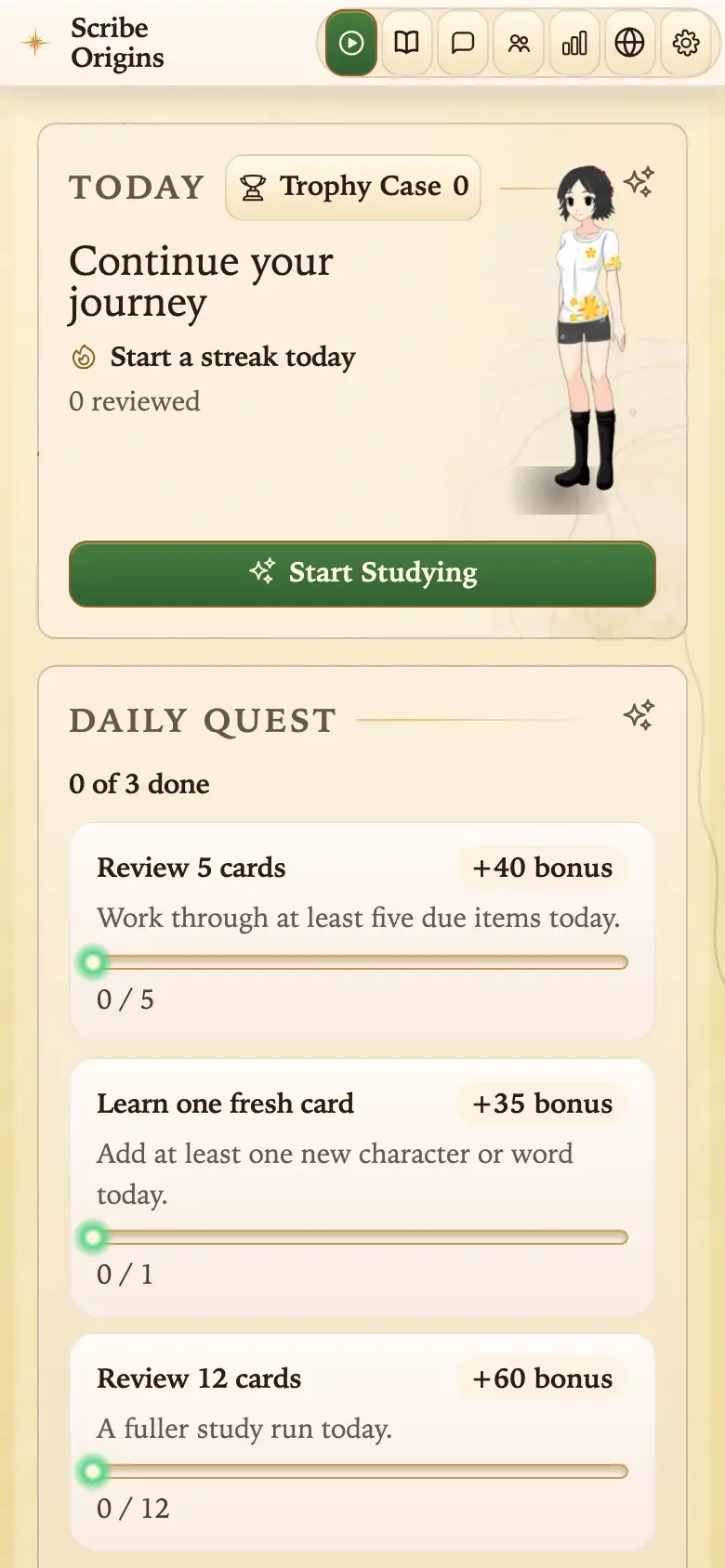
In practice a session looks like this. You land on the home screen (pictured above), where a due count tells you how many items are ready for review right now. Tapping into the study picker lets you choose a game — Flashcards, Multiple Choice, Tiles, Matchup, Character Builder, Blockfall, Tutor mode, or a Scene Conversation — and a source: a specific deck, everything due, or a fresh batch of new material. Whichever game you pick, you're reviewing the same underlying item as every other game, so there's no separate "Tiles progress" or "Character Builder progress" to manage.
What you study
Characters, vocabulary, and conversations, one system
Scribe Origins covers three layers of a language, and they all plug into the same review engine:
- Characters — Chinese and Japanese characters, shown broken into recurring component primitives so you recognize familiar parts instead of memorizing an unfamiliar whole shape.
- Vocabulary — words and readings across all six supported languages, with example sentences, similar-sounding and similar-meaning word panels, and audio pronunciation where a recording exists (speech synthesis fills in the rest).
- Conversations — full dialogue scenes with characters, branching choices, and audio, so you practice a word or phrase the way it actually gets used, not just in isolation.
Every item, no matter which of the three layers it comes from, is scheduled by the same spaced-repetition engine. That's what lets a character you first met in a flashcard deck show up again inside a scene conversation, or get tested by a Tiles match, without ever splitting into a second, disconnected progress track.
Getting started
What should I study first in Scribe Origins?
Start with one language, a beginner or themed deck, and a short recognition session in Flashcards or Multiple Choice. You do not need to choose the perfect long-term routine on day one. Once a few words feel familiar, add a conversation for context or Tutor mode when you are ready to type answers without choices.
Here is a simple first-session sequence:
- Open Scribe Origins in a browser (no install required to start) and choose your language from the language menu.
- Pick a starting deck — a JLPT/HSK level, a themed vocabulary list, or "All decks" if you'd rather let the app surface a broad mix.
- Launch Flashcards or a language game for your first batch of new items.
- Rate each review again, hard, good, or easy — this is what schedules the item's next appearance.
- Come back the next day and clear your due count; the app tells you exactly how many items are ready.
- Once the basics feel comfortable, try a scene conversation or Tutor mode to test recall in context instead of from a flashcard prompt.
There's no strict order you have to follow beyond that — some learners study characters first and add vocabulary later, others start straight into vocabulary for a language that doesn't use a character system (Spanish, Thai, and most Korean study paths skip character primitives entirely and go straight to words and conversations).
Compare
Which study mode should I use?
All modes feed the same shared review record, so switching between them is never a setback — pick based on what you want to practice right now:
| Mode | Best for | Feel |
|---|---|---|
| Flashcards | Fast daily review of due items | Quick, low friction |
| Multiple choice | Recognition practice, easing into a new deck | Relaxed, four-option guess |
| Tiles / Matchup | Reinforcing a small batch playfully | Arcade, replayable |
| Character Builder / Blockfall | Character primitive recall under light pressure | Puzzle-like, faster-paced |
| Tutor mode | Typing a real answer instead of picking one | Harder, active recall |
| Scene conversation | Using vocabulary and characters in dialogue | Contextual, story-driven |
See the full breakdown in the flashcards guide and the language games guide for what each arcade mode specifically trains.
Cost & access
Is Scribe Origins free?
Yes — Scribe Origins is free to study with. It runs entirely in your browser and keeps your review history and settings on your own device automatically, so you can open the app and start a session without creating an account or entering payment details. An account becomes useful once you want to sync progress across more than one device, but it has never been required just to learn.
Because progress lives on your device by default, uninstalling the app or clearing site data without syncing first will lose local history — the same as any offline-first app. If you study on more than one device, set up account sync from Settings once, and you won't need to think about it again.
Languages
Which languages can I learn?
The Scribe Origins supported languages are Japanese, Chinese (Simplified and Traditional), Cantonese, Korean, Spanish, and Thai. Coverage varies a little by language:
- Japanese and Chinese have the deepest character coverage, including primitive breakdowns, built-in mnemonic stories, and JLPT/HSK-style deck levels.
- Cantonese ships as vocabulary and conversations rather than a dedicated character module.
- Chinese Traditional ships characters and conversations, with vocabulary content still filling in.
- Korean, Spanish, and Thai focus on vocabulary and conversation practice, with Thai adding color-coded tone markers similar to the Chinese tone chips.
Whichever language you pick, the same spaced-repetition engine, the same game modes, and the same shared review record apply — learning a second language later doesn't reset anything from the first.
Offline & install
Does it work offline?
Yes. Scribe Origins is a Progressive Web App (PWA): install it to your Home Screen, Dock, Start menu, or application launcher for a focused app window. Core app files and language content that has already loaded can remain available without a connection. Reviews and settings are stored locally first; account synchronization resumes when the app is online. New server data, unopened content, sign-in, and community activity still need a connection. See the install guide for browser-specific steps and an offline-readiness checklist.
Language references
Grammar guides for every supported language
Use the guide for your target language to check sentence structure, word order, register, writing systems, and common learner questions. Each page states its variety and notation scope.
Guides
Every help topic
The overview above answers the big question — how do I learn a language with Scribe Origins — at a glance. Each guide below goes deep on one part of the app:
FAQ
Frequently asked questions
How do I use Scribe Origins?
Open the app, choose the language you want to learn, and begin with a small Flashcards or Multiple Choice session. Scribe Origins schedules each item with spaced repetition and keeps one shared review record per item across its study modes, so you can change games without losing progress.
What should I study first in Scribe Origins?
Start with one language, a beginner or themed deck, and a short recognition session. Once a few words feel familiar, add a conversation for context or Tutor mode for harder typed recall. The broader learning method guide can help you build a daily routine after you know how the app feels.
Is Scribe Origins free?
Yes. You can study with Scribe Origins without paying anything. The app runs entirely in your browser and stores your progress on your device, so there's no forced signup just to start a session. An account is optional and only needed to sync progress across devices.
Which languages does Scribe Origins support?
Scribe Origins currently supports Japanese, Chinese (Simplified and Traditional), Cantonese, Korean, Spanish, and Thai, with character, vocabulary, and conversation content varying by language.
Does it work offline?
Yes, for app files and learning content that has already loaded on the device. Install Scribe Origins, open the languages and study features you need while online, and test them before a trip. New server data, unopened content, sign-in, forums, and cross-device synchronization require a connection.
Do I need an account to save my progress?
No. Scribe Origins saves your review history and settings locally on your device automatically. Creating an account is optional and only needed if you want to sync your progress across multiple devices.
Start here
How do I learn a language with Scribe Origins during my first seven days?
If your question is how do I learn a language with Scribe Origins, start with one language, one small daily review target, and one meaningful activity. The app contains many modes, but a beginner does not need to open all of them at once. The first week should teach you how sound, writing, vocabulary, grammar, and review connect.
- Day 1 — choose the reference point: set the language you are learning, open its grammar guide, and read the overview of sound, writing, and basic word order. Learn what pronunciation or romanization system the guide uses.
- Day 2 — inspect real entries: search the Dictionary for several words from a beginner lesson. Listen, read an example, and save only the items you expect to use again.
- Day 3 — learn the review controls: complete a short flashcard session and rate recall based on the answer you produced before revealing the card.
- Day 4 — add context: preview a conversation scene with both native text and translation, then replay with the translation hidden.
- Day 5 — strengthen the weak direction: type or say answers in Tutor mode, or use a game that tests the character components or recognition contrast you find difficult.
- Day 6 — write a retrieval cue: add a short note, contrast, or memory story to two items you repeatedly miss.
- Day 7 — review and produce: clear a manageable group of due items, then use five of the week's words in a spoken or written summary.
The goal is not to complete the library in seven days. It is to establish a loop: encounter language, understand it, retrieve it, use it, and revisit it after a delay.
Choose by goal
Which Scribe Origins help guide should I read first?
| Your immediate question | Start with | Then use |
|---|---|---|
| How should I organize daily study? | Learning method | Spaced repetition |
| How do I remember words and characters? | Flashcards | Stories and notes |
| How do I understand a word I found? | Dictionary | Grammar guides |
| How do I practice listening and replies? | Conversations | Tutor Mode |
| How do I learn kanji or Chinese character structure? | Character components | Language games |
| How do I ask another learner? | Forums | Editorial standards |
| How do I install or use loaded content offline? | Install guide | Settings |
You do not need to read every guide before studying. Open the guide that removes today's obstacle, apply one instruction in the app, and return to the library when a new obstacle appears.
Session plans
What can I do in Scribe Origins in 10, 20, or 45 minutes?
A 10-minute maintenance session
Review due items for six minutes, then spend four minutes on the two mistakes that repeated. Open their details, compare the confusing forms, or add a short note. This is enough to keep contact with the language on a busy day.
A 20-minute balanced session
Spend eight minutes on due review, seven minutes on a conversation or grammar example, and five minutes producing answers without choices. Keep new items low enough that tomorrow's review remains manageable.
A 45-minute development session
Use 15 minutes for mixed review, 15 for new input, and 15 for output. New input can be a scene, grammar section, or dictionary exploration; output can be Tutor mode, a short forum question, a written paragraph, or spoken substitutions based on a dialogue.
The exact minutes can change. A balanced session matters because it answers how do I learn a language with Scribe Origins in actions: remember older material, understand something meaningful, and produce language before the session ends.
Use the library
How are Scribe Origins help pages different from quick tips?
Each help page states its scope, author, update date, sources, and related reading. Product guides distinguish current interface behavior from general learning advice. Language lessons identify the script, variety, or romanization they use and provide reference sources. This lets you judge whether an answer applies to your language, region, level, and version of the app.
Why do question headings repeat ideas from the title?
Readers arrive with related but not identical questions. A page about flashcards may need to answer rating, backlog, card design, and transfer. Clear question headings make those answers scannable and allow search engines to match a specific problem without hiding keywords in metadata.
Should I trust every example without checking it?
Use examples as models within the page's stated scope. Language changes by region, relationship, medium, and time. For a high-stakes message or specialized claim, compare an established reference and ask a focused question that names the situation. Corrections can be reported through Support with the page URL and nearest heading.
Next step
How do I know what to study next?
Use errors as routing information. If you know a meaning but cannot hear the word, choose listening. If two characters merge visually, compare components. If every word is known but the sentence remains unclear, open the grammar guide. If you recognize answers but cannot produce them, type or speak before revealing choices. If the issue is regional or social, ask the community with context.
This diagnostic habit is the durable answer to how do I learn a language with Scribe Origins: the app does not need to decide every next step for you. The nature of the last error points to the most useful guide, mode, or practice task.
Common learner questions
Should I study grammar or vocabulary first when learning a language?
Study a small amount of both from the beginning. Vocabulary gives you content to understand and express; grammar shows how those words relate. Ten isolated words are difficult to use, while a grammar rule with no familiar words remains abstract. A practical beginner unit is one sentence pattern plus five to ten words that fit it. Reuse the same pattern with new people, objects, places, or times.
When a sentence is unclear even though you know every word, grammar deserves attention. When you understand the structure but cannot identify the key noun or verb, vocabulary is the gap. Let the error decide which side receives the next few minutes.
How many new words should I learn per day?
Choose a number that leaves enough time to review older words and meet the new ones in context. For many beginners, five to fifteen carefully chosen items can be more sustainable than a large daily import. The correct number is not a universal target: reduce it if tomorrow's due queue keeps growing, if meanings blur together, or if new words never appear in sentences.
Count usable encounters rather than list size. A word you can recognize, pronounce, and understand in one sentence is more valuable than five translations you saw once. Increase new material only after the review load and accuracy remain stable for several days.
How long does it take to learn a language?
The answer depends on the language, your previous experience, desired level, available exposure, and what “learn” means. Ordering food, reading simple stories, following television, and working professionally are different outcomes. Measure progress in tasks: understand a familiar scene without translation, hold a three-minute exchange, or read a page with limited lookup.
Weekly task samples show change more clearly than waiting for a moment when the language suddenly feels complete. Expect different skills to advance at different rates; reading can outpace listening, and recognition can outpace speaking.
Should I learn two languages at the same time?
You can, but give each language a clear time, purpose, and review queue. Closely related languages may interfere when both are new, while an established language can coexist more easily with a beginner one. If you repeatedly answer in the wrong language, miss reviews, or avoid meaningful input because administration takes too long, reduce the load.
For most beginners, one primary language creates faster momentum. Add another after the first has a stable routine and enough context that its words no longer feel like an undifferentiated list.
Build consistency
How can I make language learning a daily habit?
Attach a small language action to a stable part of the day: after breakfast, during a commute, or before evening entertainment. Define a minimum that takes less than ten minutes, such as reviewing due items and saying two sentences. Starting should require no decision about which resource to open.
Prepare the next task before finishing: leave one scene, grammar section, or short reading selected. Track completion, but review ability weekly so a streak does not replace learning. When a day is missed, resume with the minimum instead of creating a punishment session. Habits become durable when returning is easy.
How is this learning library maintained?
Product guides are checked against the current application. Language references identify their scope and link to established language authorities; learning-method pages separate published research from Scribe Origins product decisions.
- Scribe Origins editorial standards — how product claims, examples, sources, and corrections are handled.
- Meet the authors — Aiko, Grace, and Kaito’s profiles and the topics they cover.